Saturday, 12 September 2015

Post No. 755 - For Sunday evening’s meditation-clearing


I’ve introduced something new: a map of the energy states of a few places. This is intended to give an insight into the balance or lack thereof of each element, and the overall mix of elements, with a view to being able to focus on which type of energy to best send (or clear).

For everyone’s convenience, I’ve shifted the reminders / explanations about Sunday’s meditation-clearing to this post. I have a simplified blogiography of posts related to this work here, a list of themes I have identified here, and my changing the personality of oppressors post, which I am contemplating expanding to include some key people to work on, is here. (Also, see here for some investigation into evidence of the effectiveness of this type of work, which shows variability [and mentions causes] and cycles in the energetic/consciousness response.) A range of information on emotions is here, and suggestions on how to work with emotions is here.

The purpose of posting these news links is not only to inform: it is also to stimulate a connection to nonBPLF units that need to be cleared and BPLF units that need to be strengthened. That only works if you don’t let yourself be overwhelmed by this, so take it in small chunks if you need to, but remember to actively clear and heal! … including yourself.

Also, in the same way that activists used to argue that “the personal is political”, the energies we use and manifest in our daily lives contribute to the larger soup of energies that influence world events. If you want to, for example, improve the communication of nations, improve yours. To help stop abuses of power, be always ethical in your conduct. Want peace? Then work in an informed, understanding, intelligent and nuanced way for peace in yourself and your life.
Now, the themes – short, medium and long term - that come to mind for my work this week, after I review all this news, are (and no apologies if this repeats the themes of any previous weeks – in fact, given the size of this task, that is to be expected):
   (a)   based on my interpretation of information here and here with Saturn in Sagittarius contributing to finding an authentic balance (until 20th December, 2017), Uranus in Aries contributing to fresh and possibly radical starts (until some date in the Year 2018), and Pluto in Capricorn contributing to a transformation of power and business (and careers) (until some date in the Year 2024), conditions are ripe for a change for the better in world politics;
   (b)   there is an enormous need to clear nonBPLF energy – the thought forms, unattached energy and scars of the collective unconscious created by millennia of violence. This need includes rescuing those who have been trapped by that history, and healing the warped views, seemingly “inherent” biases, and other damage done by the physical, emotional, mental and spiritual violence committed on scales large and small in that timeframe;
   (c)   viewing the overall emotional state of the world from an elemental point of view, region specific divinations and suggestions are shown below. From the news,
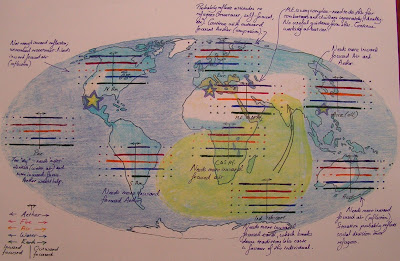
overall, we have an excess of fire energy;
   (d)   we need more trust in the potential for goodwill of others, including supporting good or potentially good proposals;

News and other matters from this week include the following (opportunities/good news are shown in green; comments are shown in purple; WARNING: some of these links may contain triggers around issues such as violence, sexual assault, discrimination, etc).
   permanent issue: may all actual and potential BPLF [1] Leaders be kept BPLF safe, including keeping them undetectable to the nonBPLF and keeping all their Significant Others inviolable against being used for indirect psychic attack, all as is for the Highest Spiritual Good;

   with regard to democracy, freedom and governance:   an interesting assessment of whether or not it is an offence to “insult” a Royal Commissioner (I would have liked the consideration to separate the issue of criticising the actions and conduct of the Royal Commission to criticising the motives of those who created it and the terms of reference they created for it);   in a current by-election in Australia, both main party leaders are – concerningly - playing the xenophobia line;   the High Commissioner for Human Rights, Zeid Ra'ad Al Hussein, has condemned the ongoing crackdown on civil society and independent voices in Azerbaijan;   concerns that a proposed 'economic reconciliation' law will provide impunity for corruption and economic crimes, threatening the transitional justice process and deflecting the message at the heart of the Tunisian revolution, which started the Arab Spring (sometimes known as the Arab Spring and Winter);   an Australian politician has turned to poetry to attack the recent “Australian Border Farce”;   criticism of the proposed Australian intake of Syrian refugees (later changed to accepting a further 12,000 refugees on top of current intake);   more concerning allegations of abuse of refugees in Australia’s refugee prison in Nauru;   calls for greater numbers of indigenous people in Australia’s Senate;   the Under-Secretary-General for Peacekeeping Operations, Hervé Ladsous, has praised the Liberian people for their ability to overcome recent adversity, including civil wars and the recent Ebola outbreak.  Mr. Ladsous stressed that now is the time to focus on the important work of continuing to build a unified and reconciled nation with an accountable Government committed to addressing corruption;   Thailand’s military junta has secretly detained a former Minister;   an editorial on a state election in India in which caste is a major factor;   Brazilian police have sought permission from the Supreme Court to question ex-President Luiz Inacio Lula da Silva over the Petrobras corruption scandal;   concerns that the super-rich are threatening the USA’s democracy;  an assessment that “refugee crises” are “spilling over” into domestic politics;   a critique of the Australian political system;

   with regard to Da’esh and violent extremism generally:   14 police officers in Turkey have been killed by a PKK bomb attack, which right wing violent extremists in Turkey have responded to by violent attacks against the premises of a pro-Kurdish political party, amid concerns over vigilantes being encouraged by officials, and further airstrikes have occurred;   an analysis that US foreign policy shortcomings is stopping Iran and the US cooperating against Da’esh; four people have been killed in fighting against the PKK in Iran;   three men with a suspected bomb in Nairobi, Kenya have been arrested at a shopping centre;   an assessment that Da’esh may be developing a cyberwar capability;   description of a post fighting Da’esh, where Peshmerga and PKK – who fought each other a few decades ago – are cooperating, and – notwithstanding the US military’s reluctance – women are in combat roles - as they have in the past (see here, here, here, and here), but the civilians may be indifferent;   2 “militants” and 4 soldiers have been killed in Jammu and Kashmir;   violent extremists have been using a mobile phone “technological breakthrough”, developed after Hurricane Sandy to ensure communication without mobile phone towers, to avoid detection;   the US government is increasingly convinced that Da’esh is making chemical weapons;   soccer is being used to help de-radicalise jailed members of Boko Haram in Nigeria;   a review of the “War of Terror” which finds it has resulted in 370,000 deaths (210,000 of them civilians) and 7.6 million people displaced;   an opinion piece arguing that the USA’s ally Saudi Arabia, not Iran, is “the leading purveyor of radical Islam”;   an excellent response to proposals to build a wall along the US-Mexico border;

   with regard to refugees:   some better attitudes towards refugees: see here, here, here, here, here and here;   a critique of Australian Prime Minister Abbott’s “distortions” (are they really lies? Eventually he gave in to pressure and accepted an extra 12,000 Syrians on top of existing limits – see here for a critique of the conditions of his response), and the story of one refugee who was successful through current officially accepted channels (how do these people cope with the blatant hostility towards migrants that has been created by violent right wing extremists in Australia?);   a call for the European Union and its 28 member states to act immediately to address the human rights crisis resulting from years of mismanaging migration and asylum, with five excellent specific suggestions that, in my opinion, other nations would do well to emulate;   the United Nations' top official in charge of migration says that the crisis rocking Europe needs a "global response" amid a warning from the European Union that the situation could last for years;   a fact check on Australia’s acceptance of refugees (which equates to refugees being 0.06% of the total population – hardly a crushing swell of people, is it?);   another article suggesting refugees can aid with ageing problems and, in this instance, other economic problems that Germany has;   more concerning allegations of abuse of refugees in Australia’s refugee prison in Nauru;   an analysis of the US position with regard to Syrian refugees;   France will now accept 24,000 refugees, which is a major change of political position – backed by some mayors and others in France, and opposed by other people;   an excellent critique of Australia’s mixed responses to refugees;   European Commission President Jean-Claude Juncker devoted almost an hour of his State of the Union address to refugees, including saying “It is a matter of humanity and human dignity, and for Europe, of historical fairness”;   a review of current refugee processing approaches (Africa’s looks good), and a call for Europe to adopt country of first application, rather than country of first arrival;   a criticism of the response to the refugee crisis by the rich Gulf states as inadequate;   a call for refugees to be called that, not migrants (I support that);   the importance of people power in changing politicians stances;   abysmal conditions in Hungarian detention camps;   Eastern European nations have rejected refugee quotas;   concerns over Germany’s capacity to cope with refugees, and the permanence of its welcoming;

   with regard to human rights and discrimination:   the Victorian government plans on standing up to pressure from religious groups to discriminate;   a gay rights group in Bangladesh has launched the country's first ever lesbian comic strip character in a bid to raise awareness about the plight of homosexual people;   more on the discrimination against children with disabilities in South Africa, particularly around education;   a damning report has found that bullying, discrimination and sexual harassment are rampant in the surgical profession in Australia (see also here);

   with regard to crime, judicial matters and policing:   there has been another allegation of assault against police on the Gold Coast. Looking at the footage of two of the incidents, thinking of the time frames, and knowing that police are taught not to behave like this, I am inclined to the view that an uncooperative could be influencing police in that region - the situation feels similar to a cluster a car accidents that I cleared – and wrote about - a little while ago. The solutions here are multiple: what those reading this blog can do, is (a) send feelings of determination to be ethical to police in that region, and (b) find and clear any uncooperative(s) who are causing or contributing to the problem ( (c) it would also help for people to know of psychic risks and how to defend themselves against them, but I suspect that will be a long time away). This sort of situation is exactly the sort of reason I started doing this sort of work;   there may be a limited “strike” by police in my home state, in that they may not issue speeding fines in protest over pay problems. They are entitled to take peaceful industrial action (see here and here), but I hope no-one here is stupid enough to try to take advantage of it: the laws about speeding have a valid reason – safety;   the Australian Federal Police have put nearly 2,000 people at risk of the death penalty: is this them trying to “get around” the Australian ban on the death penalty  including specific guidelines on this issue, or they really “just” professionally  inept?;   concerns over a sentencing that appear valid, but I have not read other views;   reports a man has been beaten to death by police;   a police officer is in a serious condition after being bashed by five men;   concerns over apparent attempts to politically influence police in India;   privacy and technical concerns over a proposed facial recognition system;   concerns over escalating violence, including by police, in demonstrations in Lebanon, and also over police response to protests over proposed laws;   excessive violence used by US police – and on the wrong suspect;   a spate of violence against women in Australia;   an excellent report on domestic violence;

   with regard to media and freedom of expression:   the High Commissioner for Human Rights, Zeid Ra'ad Al Hussein, has condemned the ongoing crackdown on civil society and independent voices in Azerbaijan;   an article alleging the demise of objective reporting, following the hypocritical claim by an Australian government minister that one media branch was agitating for its demise, with a counter view here;   concern over attacks on the media in Turkey;   the Ecuadorean government is apparently trying to shut down a media freedom group;

   with regard to overcrowding and “modern” lifestyle issues:   these (here and here) are symptoms of our push to be competitive, and of how one nonBPLF person can cause that behaviour in others in a workplace;   in favour of not living together;   appalling attack on a homeless man in Perth;   the problem of “colonial nostalgia”;   productivity and attitude in the workplace;   the Food and Agriculture Organization (FAO) recently released its Global Forest Resources Assessment 2015 report, saying that the world's forests continue to shrink as populations increase and forest land is converted to agriculture and other uses;   a call for more sensible starting times for work and schools;

   with regard to education:   more on the discrimination against children with disabilities in South Africa, particularly around education;

   with regard to the conflict in Afghanistan (noting that Afghanistan was once a peaceful and modern society, even allowing women in miniskirts, before the Russian invasion – see here):   the complex situation in Afghanistan;   UN aid agencies and their partners have warned that the number of people struggling to cope with food insecurity in Afghanistan has doubled in the last year, to 1.5 million;   an article arguing that the Afghani government needs to focus on holding those parts of the nation that it can, in order to be better placed to force the Taliban to negotiate;

   with regard to China:   China and Taiwan have each held military exercises – including live fire – in the Taiwan Straits;

   with regard to the conflict in Iraq (noting that Iraq was once a peaceful and prosperous society, before the USA / CIA backed revolution – see here):   cautious hope for Iraq;

   with regard to the Libyan civil war:   a new round of UN-facilitated political dialogue with Libyan parties has started in Morocco;

   with regard to Russia:   former US intelligence contractor Edward Snowden has criticised Russia — the country that has granted him asylum — calling its crackdown on human rights and online freedom "fundamentally wrong", as he accepted a Norwegian freedom of expression prize by videophone from Russia;   the USA is concerned at Russian military influence in Syria;   a more nuanced view of Putin which finds that, although he is no economist and the Russian military has flaws and Russia has weaknesses and other problems, Putin’s strategy – not his public speeches – has been reasonably successful –which, from a spiritual point of view, confirms the bullying and Imperial nation of Putin and Russia, not to mention the attempts Putin is making to kill Russian children;

   with regard to Sudan and South Sudan:   the World Food Programme (WFP) and UNICEF are intensifying their efforts to reverse the dire malnutrition situation in South Sudan;   a South Sudanese government special force has gone on a killing and rape rampage;   the UN Resident and Humanitarian Coordinator in Sudan, Marta Ruedas, strongly condemned the fatal attack carried out Tuesday, 8 September, in West Darfur against aid workers from the State Ministry of Health and World Health Organization;

   with regard to the conflict in Syria:   the USA is concerned at Russian military influence in Syria (allegedly to capitalise on US reluctance to get involved, and solidify their influence), and reports suggest Russians are now taking part in anti-rebel actions (claims backed up by Israel);   the UN Special Envoy for Syria, Staffan de Mistura, has discussed how, after five years of conflict in that country, Syrians are giving up hope, with many fleeing to Europe as the fighting continues. He added that the arrival of Syrian refugees is placing enormous pressure on Europe at the moment, and – with the UN Secretary-General - urged Europe to respond by receiving refugees with dignity. At the same time, the Special Envoy said, there is a need to create hope for the Syrians, and he noted that has been the purpose of the Geneva consultations. He said that the Geneva Communiqué is a roadmap which offers an opportunity for discussion. The alternative, he warned, is that Da’esh will continue to advance, while the only losers will be the Syrians. Others (UNHCR and WFP) have talked of the problems of the 4 million refugees in neighbouring countries;   an excellent analysis of the problems associated with a “no fly zone”;   Iran’s ambassador to Australia has argued that Assad’s brutal government in Syria should not be toppled “because it is the only bulwark against Da’esh”;   the UN Secretary-General has welcomed the authorisation by the Security Council of his recommendations to establish and operate the Organisation for the Prohibition of Chemical Weapons (OPCW)–UN Joint Investigative Mechanism;   a call for Western citizens who are pressuring their governments into accepting more refugees to also push their governments into rethinking their approach to Syria;

   with regard to Turkey:   Turkish troops have crossed into northern Iraq in pursuit of elements of the PKK;   14 police officers in Turkey have been killed by a PKK bomb attack, which right wing violent extremists in Turkey have responded to by violent attacks against the premises of a pro-Kurdish political party, amid concerns over vigilantes being encouraged by officials, and further airstrikes and demonstrations have occurred;   concern over attacks on the media in Turkey;   critical reactions to the government’s change of attitude towards the PKK;   concerns over election security;   a call for Turkey to develop a new political centre;   at least 30 people have died in clashes in the Turkish city of Cizre since a military operation began there last week;

   with regard to the conflict in eastern Ukraine:   nearly 8,000 people have been killed in eastern Ukraine since mid-April of this year, the High Commissioner for Human Rights said today, releasing the 11th and latest report by the UN Human Rights Monitoring Mission in the country;   an assessment that Donbass is clinging to an illusion of peace;   Ukraine has referred the violence in the nation to the International Criminal Court: this article reviews what could happen next;

   with regard to the war in Yemen:   the Office for the Coordination of Humanitarian Affairs (OCHA) says that the incidence of Global Acute Malnutrition in Yemen’s Aden Governorate reached critical levels in August. It now stands at 19.2 per cent, compared with 10.3 per cent in 2014;   some Yemeni refugees are returning to Aden, as it appears African refugees were forced to return to their nation of origin, despite having lived in Yemen for perhaps decades;   the Food and Agriculture Organization (FAO), the World Food Programme (WFP) and the Office for the Coordination of Humanitarian Affairs (OCHA) signed an agreement in Riyadh today with the King Salman Humanitarian Aid and Relief Centre, for $5.8 million, $142.8 million and $8 million, respectively, in funding to support the aid operation in Yemen. The remaining Saudi pledges to UN agencies are for the Office of the High Commissioner for Human Rights (OHCHR) for $525,000 and the UN Population Fund (UNFPA) for $2.5 million;   the Special Envoy for Yemen, Ismail Ould Cheikh Ahmed, has welcomed the commitment of the Government of Yemen, the Houthis and the General People's Congress to join peace talks that he will convene in the region next week;   concerns over the Saudis bombing a boat with Indians;

   with regard to the natural and other catastrophes :   a sandstorm has killed at least two people in the Middle East;   flooding and landslides in Japan have led to tens of thousands being evacuated;
Also from the Daily Briefings of the United Nations (UN) (and other sources):
   speaking at the General Assembly Informal Interactive Dialogue on the Responsibility to Protect (R2P), the Secretary-General has urged governments and UN entities to do more to act early, prevent atrocity crimes and support states in protecting their citizens. In 2005, world leaders adopted the World Summit Outcome to protect populations from the most egregious international crimes and to assist one another in this effort. Ten years on, the Secretary-General urged Member States - especially the Security Council - to move from understanding to action. He outlined three steps– the need to create political space to prevent and respond to atrocity crimes; a stronger connection between early warning and action; and courage in publicly confronting and addressing signs of risk;

  the Office for the Coordination of Humanitarian Affairs (OCHA) has said that almost 18,000 people crossed from Venezuela into Colombia between 21st August and 6th September, according to the Government of Colombia. Aid organizations on the ground report that people continue to arrive each day, despite deportation having currently stopped, and are working with the Government to address immediate humanitarian needs of families who are arriving, particularly in regions where state infrastructure is less strong;

   the Under Secretary-General for Peacekeeping Operations, Hervé Ladsous, has just wrapped up his four-day visit to the Central African Republic today. He announced the establishment of a “weapons-free zone” in Bambari, following his visit to the area, a decision which was taken to ensure the free movement and physical integrity of the civilian population, as well as humanitarian access to vulnerable populations;

   a new report from the Office for the Coordination of Humanitarian Affairs (OCHA) showed that, according to official data released by the Israeli authorities, more than 11,000 demolition orders - affecting an estimated 13,000 Palestinian- owned structures, including homes - are currently 'outstanding' in Area C of the West Bank;

   in his message for International Literacy Day, the Secretary-General has called on governments and partners, including the private sector, to join forces to make universal literacy an essential component of the future we want;

   Nickolay Mladenov, the UN Special Coordinator for the Middle East Peace Process, said that the decision announced today to postpone the meeting of the Palestine National Council shows leadership and wisdom. He said that the postponement would give adequate time for consultation with all factions in preparation of a regular session, which should strengthen unity and chart the way forward. Mr. Mladenov urged all Palestinian leaders and factions to seize this opportunity to take constructive steps towards achieving genuine Palestinian unity;

   child mortality rates have plummeted to less than half of what they were in 1990, according to a new report released today by UNICEF, the World Health Organization (WHO), the World Bank Group, and the Population Division of UN Department of Economic and Social Affairs (DESA);

   Envoys from the Russian Federation, the United States, the European Union, and the United Nations met with Saudi Arabian Foreign Minister Adel Al Jubeir and the Secretary-General of the Gulf Cooperation Council, Dr. Abdul Latif Al Zayani, to discuss how to preserve the two-state (Israel and Palestine) solution, and how to create conditions that will enable the parties to return to meaningful negotiations with the goal of achieving a two-state solution;

   the Food and Agriculture Organization (FAO) announced today that its Food Price Index registered its sharpest fall since December 2008;

   the Secretary-General has relayed concerns about the border problems to the Foreign Ministers of Colombia and Venezuela, and taken note of their issues;

   the Secretary-General has presented his agenda today to take forward the recommendations of the High-Level Independent Panel on Peace Operations. Whilst the fundamentals of UN peace operations will not change, he believes three fundamental changes are urgently required to adapt UN peace operations to today’s and tomorrow’s challenges: (1) prioritise prevention and mediation if we are to break the cycle of responding too late and too expensively, (2) change the way we plan and conduct UN peace operations to make them faster, more responsive and more accountable to countries and people in conflict, (3) put in place a global-regional framework to manage today’s peace and security challenges, starting with a reinforced partnership between the United Nations and the African Union. He sets out a detailed action plan to set in motion these changes (see also here, for an opinion on the UN potential to prevent violent conflicts);

   the Secretary-General is closely following the situation in Nepal and is concerned about the recent violence and saddened by the loss of lives. He stressed the importance of dialogue and non-violence as well as respect for peaceful protest and freedom of assembly, welcomed the decision of the political parties to temporarily pause the constitution voting process and urged all stakeholders to use this opportunity to engage in meaningful dialogue at this historic opportunity that Nepali leaders have to promulgate a constitution that addresses the root causes of past and potential conflict and has the widest popular support;

   the Office for the High Commissioner for Human Rights (OHCHR), Zeid Ra’ad Al Hussein, has expressed serious concerns about ongoing forced evictions of Roma and travellers in a number of European States, including most recently in France and Bulgaria;
From other sites (note that articles from these sites may have already been provided):
   Human Rights Watch also has:   a Brazilian court is considering a case which may lead to decriminalisation of drug possession;   the killing (including of children) and dispossession of tribal people in the Philippines by soldiers attacking the insurgency in the south has led to a public furore;   an annual report found  cluster munitions were use in Libya, Sudan, Syria, Ukraine, and Yemen in 2015;   a call for Malaysia to drop charges against 8 peaceful protestors;

   the Global Centre for the Responsibility to Protect (R2P) also has:
    an occasional report, aiming to give background, offer analysis, track international response and suggest necessary action, for four nations in immediate crisis (“mass atrocities are occurring and urgent action is needed”: Syria, Iraq, Sudan and South Sudan), three nations at imminent risk (“the situation is reaching a critical threshold and the risk of mass atrocity crimes occurring in the immediate future is very high if effective preventive action is not taken”: Nigeria, Democratic Republic of Congo and Burundi), and five nations for which there is serious concern (“significant risk of occurrence, or recurrence, of mass atrocity crimes within the foreseeable future if effective action is not taken”: Central African Republic, Burma/Myanmar, Libya, Yemen and Pakistan);
   Recommended actions are:
   in Democratic Republic of Congo (I will work through other nations from the report in coming weeks):
      The DRC government and MONUSCO must ensure that the protection of civilians remains their primary priority, and must increase their capacity to respond to early warning of attacks by these groups. MONUSCO should also support the government in facilitating local peacebuilding initiatives and encourage civil society to help facilitate DDRRR;
      The FARDC must not permit individuals who have previously committed atrocities to join its forces and should train all recruits in the protection of civilians, respect for human rights and IHL. The government should adopt legislation establishing specialized mixed chambers in the national judicial system and remove all FARDC members accused of serious human rights violations from leadership positions;
      Together with the UN Special Envoy for the Great Lakes Region, the AU, ICGLR and SADC should ensure that all signatories to the Peace, Security and Cooperation Framework continue to fulfill their commitments. Perpetrators of mass atrocities, including leaders of M23, ADF and FDLR, must be held accountable.
      Energetically speaking, more Æther to contribute to people being serious about their obligations would help.

   the US-based and -centric “War on the Rocks” blog (which I have found may also have other articles that I have concerns with - and thus do not provide links to, unless I want you to think … :) ) also has:   a more nuanced view of Putin which finds that, although he is no economist and the Russian military has flaws and Russia has weaknesses and other problems, Putin’s strategy – not his public speeches – has been reasonably successful –which, from a spiritual point of view, confirms the bullying and Imperial nation of Putin and Russia, not to mention the attempts Putin is making to kill Russian children;   the complex situation in Afghanistan;   an assessment of the benefits of the US-South Korean alliance, including prevention of war;   an assessment which suggests, given Da’esh’s brutal repression of dissent, supporting the YPK in Raqqa is the best move against Da’esh – but Turkey is a problem there;

   the Justice in Conflict blog has:   an analysis of whether the trial of a thug wanted for war crimes and crimes against humanity in the Democratic Republic of Congo threatens to discredit – or worse – the Rwandan government;

   the Political Violence at a Glance blog has:   “practical compassion in the Age of Crisis”;   how the UN could contribute to the prevention of violent conflicts;   the presence of militias make violence more likely;

   the Institute for War and Peace Reporting also has:   nearly 30 people have died in recent days as government forces in Tajikistan tackle a rebellion led by a top defence official;   the European Court of Human Rights (ECHR) issued a landmark ruling in June in favour of displaced people on both sides of the Nagorny Karabakh conflict, but political stalemate is likely to draw out the process of paying reparations to families displaced by war;

   the “Wronging Rights” blog has:   a report on the human rights situation of Tamil women – which is being made worse by gender-stereotyped assistance;

   the Middle East Eye also has:
 - Egypt may make a cabinet reshuffle after a Minister was arrested on corruption charges;   suggestions that concerns over possibly being arrested for war crimes may be delaying Egyptian President al-Sisi’s visit to the United Kingdom;   Israel has reopened its embassy in Cairo;
 - problems of blind people in Morocco;
 - a critique of the current protest movement in Lebanon, including historical comparisons;   the Lebanese cabinet has approved a plan to end the rubbish crisis (now to see what is actually delivered … );
 - pro-Palestinian and pro-Israel protestors demonstrating Netanyahu’s arrival in London may have both been against Netanyahu;   a call for pro-Palestinian support to be extended beyond Western nations;
 - concerns over Saudi Arabia’s deficit;   a crane collapse has killed 87 and wounded nearly 200people at a mosque;

   The Hindu also has:   an editorial welcoming the guilty verdict a court martial has brought against six soldiers on charges of murder, which will reinforce the message of accountability for the military in Jammu and Kashmir;   an Indian police raid on a Saudi diplomat’s house for allegedly kidnapping, raping and torturing two women has resulted in diplomatic protests;   an editorial on the irrational violence of killing people who challenge belief systems;   a call for “counterspeech”, rather than law enforcement, to address the problem of “dangerous speech” (a subset of “hate speech”);   more airport security check problems, this time for a disabled person;   concerns over the lack of details in the Naga peace agreement;

   the BBC also has:   prominent Venezuelan opposition leader Leopoldo Lopez has been sentenced to 13 years and nine months in prison;

  the (South African) Mail & Guardian also has:   fiery South African politician Julius Malema has been ejected from parliament after refusing to retract comments in which he accused Deputy President Cyril Ramaphosa of being a "murderer", leading to Ramaphosa claiming the ANC took corruption very seriously;   claims that the Oscar Pistorius case shows the influence that money can have on justice in South Africa;   concerns over South Africa hosting the Commonwealth Games;

   Spiegel International also has:   concerns over neo-Nazi arsonists;   disappearances of young activists in Egypt;
and from a range of other sites:
   electro-convulsive therapy is being used for severe depression. The medical profession does not understand how it works: could it be that it works through driving off obsessing/possessing spirits, as Lobsang  Rampa wrote?

   in a major development, international experts have said the Mexican government’s account of the abduction and apparent massacre of 43 students last year “does not add up”, citing deep flaws in the investigation;

   concerns over the future of the world by an academic;

   Johnny Depp and his irresponsible wife put Australia’s rabies-free status at risk when they behaved like royalty, above the law that applies to everyone else. They should belt up and cop it sweet – maybe even do something useful and advocate for people thinking before they put nations at risk of diseases or other environmental problems. Maybe have a look here, to see closer to their home the sort of problems that can happen when people ignore such regulations. Or do they genuinely think the law should not apply to them? It’s unquestionably a hard law for those who love and benefit from animals, but so is having rabies – or having to have anti-rabies shot. Perhaps the couple should try that, to see what their flouting of the law – if it had been successful  would have put an entire continent at risk of;

   Australia has been warned it could be asked to leave the Pacific Islands Forum if it does not start supporting stronger action on climate change;

   an examination of the possibility of economies being more inclusive, and less based on inequality;

   promoting a culture of peace – here, here, and, also, the Secretary-General spoke at the General Assembly high-level forum on the Culture of Peace and said that the meeting is about confronting the very hard truths in our world where people are suffering and dying from violence and atrocity crimes. He urged all those with influence to rise above their narrow interests and work for the greater good of our world. In this globalized world, we cannot turn our eyes away from or close our eyes to the suffering, and, stressing that we cannot build a culture of peace without an active campaign against division and injustice, he said that it is time to invest in young people as peacebuilders;

   the G20 finance ministers and central bank governors have committed to sustainable development;

   inconsistencies in Western attitudes towards cluster bombs;

   a call for open budget partnerships;

   allegations that staff of the company running Australia’s detention camps for refugees overseas are also subjected to bullying and sexual harassment;

   a review of the Saudi’s strategy of trying to “check” Iran, beginning with the war in Yemen;

   a critique of Australia’s flawed approach to international treaties;

   some pre-school children show psychopathic traits (since psychopaths are born and sociopaths made, that almost doesn’t surprise me by definition. However, it is no surprise to those who understand reincarnation);

   the Royal Commission into sexual abuse is forcing bystanders to address their inaction;


[1] BPLF = Balanced Positive (spiritual) Light Forces. See here and here for more on this. 
[2] Please see here, here and my post "The Death of Wikipedia" for the reasons I now recommend caution when using Wikipedia. I'm also exploring use of h2g2, although that doesn't appear to be as extensive (h2g2 is intended - rather engagingly - to be the Earth edition of "The Hitchhiker's Guide to the Galaxy").
[3] I apologise for the formatting: it seems Blogger is no longer as WYSIWYG as it used to be, and there are a lot of unwanted changes to layout made upon publishing, so I often have to edit it immediately after publishing to get the format as close to what I want as possible.

Love, light, hugs and blessings
(pronounced "new-MYTH-ear"; ... aka Bellatrix Lux … aka Morinehtar … would-be drýicgan or maga ... )
My "blogiography" (list of all posts and guide as to how to best use this site) is here, and my glossary/index is here.

I started this blog to cover karmic regression-rescue (see here and here), and it grew ... See here for my group mind project, here and here for my "Pagans for Peace" project (and join me for a few minutes at some time between 8 and 11 PM on Sunday, wherever you are, to meditate-clear for peace), and here for my bindrune kit-bag. I also strongly recommend learning how to flame, ground and shield, do alternate nostril breathing, work with colour, and see also here and be flexible.

The real dividing line is not between Christianity and Islam, Sunni and Shia, East and West. It is between people who believe in coexistence, and those who don’t.
Tom Fletcher, Former UK Ambassador to Lebanon 
Tags: activism, discrimination, energy work, magick, meditation, nonviolence, peace,  society, violence, war,
First published: Laugardagr, 12th September, 2015
Last edited (excluding fixing typo's and other minor matters): Saturday, 12th September, 2015

Saturday, 5 September 2015

Post No. 754 - Back to Melbourne

I am back to Melbourne this weekend - partly because I can do little more for my father, partly because I am needed back there and need home, and partly because of another major health problem, with my birth sister ...

Post No. 753 – For Sunday evening’s meditation-clearing

For everyone’s convenience, I’ve shifted the reminders / explanations about Sunday’s meditation-clearing to this post. I have a simplified blogiography of posts related to this work here, a list of themes I have identified here, and my changing the personality of oppressors post, which I am contemplating expanding to include some key people to work on, is here. (Also, see here for some investigation into evidence of the effectiveness of this type of work, which shows variability [and mentions causes] and cycles in the energetic/consciousness response.) A range of information on emotions is here, and suggestions on how to work with emotions is here.

The purpose of posting these news links is not only to inform: it is also to stimulate a connection to nonBPLF units that need to be cleared and BPLF units that need to be strengthened. That only works if you don’t let yourself be overwhelmed by this, so take it in small chunks if you need to, but remember to actively clear and heal! … including yourself.

Also, in the same way that activists used to argue that “the personal is political”, the energies we use and manifest in our daily lives contribute to the larger soup of energies that influence world events. If you want to, for example, improve the communication of nations, improve yours. To help stop abuses of power, be always ethical in your conduct. Want peace? Then work in an informed, understanding, intelligent and nuanced way for peace in yourself and your life.

Now, the themes – short, medium and long term - that come to mind for my work this week, after I review all this news, are (and no apologies if this repeats the themes of any previous weeks – in fact, given the size of this task, that is to be expected):
   (a)   based on my interpretation of information here and here with Saturn in Sagittarius contributing to finding an authentic balance (until 20th December, 2017), Uranus in Aries contributing to fresh and possibly radical starts (until some date in the Year 2018), and Pluto in Capricorn contributing to a transformation of power and business (and careers) (until some date in the Year 2024), conditions are ripe for a change for the better in world politics;
   (b)   there is an enormous need to clear nonBPLF energy – the thought forms, unattached energy and scars of the collective unconscious created by millennia of violence. This need includes rescuing those who have been trapped by that history, and healing the warped views, seemingly “inherent” biases, and other damage done by the physical, emotional, mental and spiritual violence committed on scales large and small in that timeframe;
   (c)   viewing the overall emotional state of the world from an elemental point of view, those continuing the fighting in Yemen are being stubborn: they need the flexibility of water. On the other hand, those responsible for the fighting in south eastern Turkey, most of whom are not in that area, are showing signs of addiction to power: they need the spirituality of Æther;
   (d)   people – including, but not only restricted to those in developed nations - need to learn the lesson of generosity;
   (e)   those in power need to learn that, no matter how much power they have, they are NOT infallible, and their grasp on power is NEVER absolute – lessons from history such as the fall of the Russian Tsar and the Roman and other empires show that. There is a basis to their power, and attempting to secure that through regressive measures may delay the inevitable – at the price of making the fall worse when it comes;
   (f)   decision makers need both accurate and true evidence, and the wherewithal to recognise that truth when they see it. “Decisions” range from world shaking government decisions down to personal reactions to news stories;
   (g)   learn from history;
   (h)   think, and do not let yourself be duped;

News and other matters from this week include the following (opportunities/good news are shown in green; comments are shown in purple; WARNING: some of these links may contain triggers around issues such as violence, sexual assault, discrimination, etc).

   permanent issue: may all actual and potential BPLF [1] Leaders be kept BPLF safe, including keeping them undetectable to the nonBPLF and keeping all their Significant Others inviolable against being used for indirect psychic attack, all as is for the Highest Spiritual Good;

   with regard to democracy, freedom and governance:   the experience of a politician who made mistakes, attempted to commit suicide, and recovered;   the Special Representative of the Secretary-General for Côte d’Ivoire, Albert Gerard Koenders, has called all political actors to show restraint on the way to the next presidential elections, to be held in October 2015;   the houses of some Indian government parliamentarians have been burned;   an opinion that the recent “Australian Border Farce” was inevitable, as tyranny against a few will become tyranny against the many, and Australia’s Human Rights Commission’s president says the power given to the force disrespect human dignity;   more abuses of power alleged in Victoria;   the impeachment motion Somali parliamentarians filed against President Hassan Sheikh Mohamud on 12th Aug has created a political standoff that might further threaten the country’s stability shortly ahead of planned elections in 2016;   the UN Secretary-General is aware of recent allegations of corruption involving President Otto Pérez Molina of Guatemala, as well as former Vice-President Roxana Baldetti. Those were brought to light by the Office of the Guatemalan Attorney General and the International Commission against Impunity in Guatemala. He trusts that Guatemalan institutions will act with transparency and responsibility to ensure accountability and provide due process for all parties involved in these allegations. Later in the week, following the decision by President Otto Pérez Molina of Guatemala to resign, the Secretary-General said that he trusts that the authorities will abide by the Constitution and ensure an orderly democratic transition. He calls on all Guatemalans to ensure that the upcoming elections are held in a peaceful environment;   the UN is concerned about reports of violence and is saddened by the loss of life in Nepal. He urges all to refrain from the use of force, denounce violence in all forms and engage in dialogue. The UN has supported the Nepali-led peace process, of which a new constitution is an important milestone, and is hopeful that the leaders will share again a spirit of compromise;   Morocco is voting in elections which may be a test of whether or not the country can transition from monarchy to democracy;   concerns over a behind-the-scenes power struggle in Algeria;

   with regard to Da’esh and violent extremism generally:   an examination of the possibility that intelligence on Da’esh is being politicised;   an article arguing that the focus on sexual violence by Da’esh needs to be broadened to consider the problem of sexual violence in the Arab world generally;   the UN Secretary-General has condemned the weekend attacks by suspected Boko Haram elements in Borno State, Nigeria, that reportedly killed over 80 civilians;   a call for action against extremist right-wing groups in India;   the U.S. has asked Pakistan to intensify efforts to counter terrorist sanctuaries inside its borders and take concrete steps against the dreaded Haqqani network responsible for major attacks on American installations in Afghanistan;   concerns that Boko Haram has spread to Lagos;   a review of the situation with regards the fight against Da’esh;   the dangers of international arms trading, with Da’esh munitions coming from the flow of conventional weapons and ammunition into the Middle East for decades;   an article on the mass rapes of Da’esh;   an appeal to recognise the dilemmas involved in working against Da’esh, and an assessment that Da’esh is still holding up against the campaigns against it;   a suicide bomber in Pakistan has killed 6 and injured 31 people;   former Afghanistan President Hamid Karzai has called upon the United States and its allies to seek advice from and consult with the “three emerging great powers” — India, China and Russia — to tackle the problem of terrorism or extremism in the world;   concerns that Da’esh could smuggle mustard gas to Europe;   the violent extremist group al Qaeda (don’t forget, not only 9/11, but that the majority of victims of that group are actually Muslims) is trying to re-brand itself as a more acceptable violent extremist group than Da’esh;

   with regard to human rights and discrimination:   an appalling plan to rape, humiliate and abuse two sisters in India as “punishment” for their brother’s alleged misdeeds;   a comparison of past and current sexual assaults in media, and reactions;   more – continuing - racism in local sport; the Israeli authorities’ declared ban on recently released Eritrean and Sudanese nationals living and working in Tel Aviv and Eilat violates their right to freedom of movement;   an article on the mass rapes of Da’esh;   the United States of “No” to human rights recommendations by its peers;   a US government official who had been refusing to issue marriage licences has – rightly – been jailed;   Pope Francis and the neochristian Catholic Church advocate discrimination against trans people, on the basis of errors of fact and truth;

   with regard to crime, judicial matters and policing:   police in Turkey have been abusing detainees, and a call for the new police head in the Philippines to address human rights abuses;   changing attitudes to solitary confinement in the US judicial system;   concerns over US police firing into moving vehicles;   corruption of Indonesian police;   anger in Azerbaijan after death of a suspect in police custody;   very good response to a Royal Commission head excusing himself using legal sophistry;

   with regard to media and freedom of expression:   a comparison of past and current sexual assaults in media, and reactions;   Indonesia’s President Joko Widodo is struggling to stop the government and military censoring journalists;   two British journalists have been arrested in Turkey on charges of having connections to Da’esh (later released);   a flawed trial has convicted an Azerbaijani journalist as legal action is taken against journalists in Kazakhstan;   an analysis of class biases in reporting on a murder in India, and criticism of reporting on another crime;   concerns over press freedom in the Arab world;

   with regard to refugees:   attacks against refugees in Germany, a review of the European situation generally, and Germany’s Chancellor Merkel says the crisis is a test of Europe’s core ideals – and see also here, here, here and here, as Hungary goes into a meltdown on the issue;   a priest has caused ruffled feathers in Transfield over their involvement with Australia's refugee detention industry;   UN Assistant Secretary-General for Humanitarian Affairs Kyung-wha Kang visited a displacement site today in North Kivu in the Democratic Republic of the Congo today, which hosts some 5,000 internally displaced people, and she said that though she had visited many displacement sites in her life, Mugunga was the toughest she had seen. The aid appeal for DRC is currently only 45 per cent funded;   the current refugee crisis in Europe is over a group constituting around 0.068% of the population. By contrast, “undocumented immigrants” in the US constitute 3.5% of the population (I would like to know what the figures are for Australia). Thus, the crisis is mostly political – and the more European leaders manifest their commitment to European values, the more they will protect European culture;   an Egyptian billionaire has offered to buy an island to develop for refugees;   the UN High Commissioner for Refugees, António Guterres, has said, ahead of key emergency meetings of the European Union, that the situation requires a massive common effort that is not possible with the current fragmented approach;   some heart-warming good news from Germany;

   with regard to overcrowding and “modern” lifestyle issues:   an appeal for a return to welcoming camper-vanning in Australia;   multitasking is a myth;

   with regard to the conflict in Afghanistan (noting that Afghanistan was once a peaceful and modern society, even allowing women in miniskirts, before the Russian invasion – see here):   a call for Afghanistan’s foreign donors to press the government to address the country’s persistent human rights problems at a major international meeting of senior officials;

   with regard to China:   China is continuing to behave like an Imperialist   military power in the South China Seas. Is this because it's military are worried that they have not had recent combat experience?;   China is “attempting to fine tune [its] transitioning economy”;   the USA has called on China to release several lawyers and Christian leaders who were detained ahead of a meeting with a senior US official;   China says it will reduce its military by 13%;

   with regard to the conflict in Iraq (noting that Iraq was once a peaceful and prosperous society, before the USA / CIA backed revolution – see here):   the UN Assistance Mission in Iraq has said that a total of 1,325 Iraqis were killed and another 1,811 were wounded in acts of terrorism, violence and armed conflict in August;   18 Turkish construction workers have been kidnapped;   an assessment suggesting the USA should be working through smaller regional players such as Kurdistan, rather than the Iraqi government;

   with regard to the Libyan civil war:   the UN Support Mission in Libya (UNSMIL) has announced that the next round of the UN-facilitated political dialogue in Geneva. The UN Secretary-General’s Special Representative, Bernardino León, has said that time is of the essence for Libya as the country continues to face more violence, a growing Da’esh terrorist threat and a collapsing currency. He added that now is the time for all leaders to set aside their differences, and put the country’s interest first and work towards the quick establishment of the Government of National Accord, as called for in the political agreement;   a car bombing. He has held consultations in Istanbul with representatives of the General National Congress to discuss ways to move forward the dialogue process;   international pressure is growing to find a political solution;

   with regard to Russia:   more children being abused in Russia: this time, children with disabilities;

   with regard to the conflict in Syria:   residents of Damascus have protested the government’s failure to lift sieges of two Alawite towns;   the UN Secretary-General’s Special Envoy for Syria, Staffan de Mistura, has met the Deputy Foreign Minister of Arab African Affairs of the Islamic Republic of Iran, Hussain Amir Abdullahian, to analyse the evolving situation and discuss efforts supporting the recent UN initiative to operationalize the Geneva Communiqué;   a call for the USA to focus on getting the Syrian government to stop its air attacks in southern Syria to open a door to peace;

   with regard to the conflict in eastern Ukraine:   violence (a grenade has killed one and injured more than 100) at a nationalist protest against parliamentary consideration of decentralisation, which is part of the ceasefire agreement;   the UN Refugee Agency has delivered humanitarian aid to Horvlika and nearby areas not controlled by the Government for the first time in several weeks;

   with regard to the war in Yemen:   the Office for the Coordination of Humanitarian Affairs has reported that citizens in Taiz have been subjected to indiscriminate violence (65 dead and 400 injured), the loss of water, sanitation and health services, and other human rights abuses, and others report serious abuses by both sides against civilians in Aden (see also here);   a major children’s hospital is on the verge of closure;   two aid workers have been killed;   the UN Secretary-General has condemned the suicide terror attacks against a mosque in the northern Jarraf district of Sana’a during evening prayers on 2nd September that left more than 30 people dead and almost 100 injured. Such attacks against places of worship are not justifiable under any circumstances;

   with regard to the natural and other catastrophes :   a rare hurricane in the east Atlantic has hit Cape Verde;

Also from the Daily Briefings of the United Nations (UN) (and other sources):

   according to the latest Food Security and Nutrition Assessment for Somalia, the number of people facing food crisis has increased by 17 per cent compared to six months ago. A total of 3.1 million people require humanitarian assistance, including an estimated 855,000 people who are food insecure;
   the Secretary-General’s Special Representative for Somalia, Nicholas Kay, has strongly condemned the attack by Al-Shabaab militants on an AMISOM base at Janaale, manned by troops from the Ugandan contingent;

   for the first time in 29 years, the flagship UN handbook Basic Facts has been published in Chinese;

   the Office of the High Commissioner for Human Rights said it deeply regretted the resumption of the death penalty in Chad;

   a new UN programme funded by Germany will help eight developing countries revamp and strengthen their climate change adaptation responses;

   the High Commissioner for Human Rights, Zeid Ra’ad Al Hussein, has said that, while far better than it was at the height of the conflict in late 2013 and early 2014, the human rights situation is still a cause of intense anxiety for both the Central African Republic’s own inhabitants and the United Nations. He added that the country is still gripped with fear, and its people remain terribly divided. He also said that the most notorious leaders are not being arrested, let alone prosecuted, tried and convicted. The UN Mission in the country needed to be reinforced with both personnel and material so they can make good on the strong Chapter 7 mandate bestowed on them by the Security Council, and the UN and the Government must do more to find solutions and bring about reconciliation between Christians and Muslims;

   the World Health Organization’s Emergency Committee (EC) has met regarding the Middle East respiratory syndrome and, whilst the situation still does not constitute a Public Health Emergency of International Concern (PHEIC), it still emphasizes a heightened sense of concern about the overall situation – particularly as the current outbreak is occurring close to the start of the Hajj and many pilgrims will return to countries with weak surveillance and health systems;

From other sites:

   Human Rights Watch also has:   concerns that US authorities are attempting to silence those being held in immigration detention centres, and those who speak on their behalf;

   the Global Centre for the Responsibility to Protect (R2P) also has:
   an occasional report, aiming to give background, offer analysis, track international response and suggest necessary action, for four nations in immediate crisis (“mass atrocities are occurring and urgent action is needed”: Syria, Iraq, Sudan and South Sudan), three nations at imminent risk (“the situation is reaching a critical threshold and the risk of mass atrocity crimes occurring in the immediate future is very high if effective preventive action is not taken”: Nigeria, Democratic Republic of Congo and Burundi), and five nations for which there is serious concern (“significant risk of occurrence, or recurrence, of mass atrocity crimes within the foreseeable future if effective action is not taken”: Central African Republic, Burma/Myanmar, Libya, Yemen and Pakistan);
   Recommended actions are:
   in Nigeria (I will work through other nations from the report in coming weeks):
      “Regional and international cooperation is crucial to defeating Boko Haram and holding perpetrators of mass atrocities accountable. Governments involved in military operations against Boko Haram need to ensure they mitigate the risk to civilians during anti-Boko Haram operations and strictly adhere to IHL and international human rights law. Families of Boko Haram members, as well as captives living in Boko Haram camps and child soldiers, need to be adequately protected and carefully reintegrated into Nigerian society.
      The UN, AU, Economic Community of West African States, ECCAS and states with significant bilateral ties to Nigeria, should assist the government in meeting humanitarian needs of affected communities and provide technical and military expertise. Captured Boko Haram leaders should be held accountable for crimes against humanity committed in areas under the group’s command and control.
      With international support, the government needs to urgently undertake security sector reform to ensure that the army and police are trained to protect civilians and prevent mass atrocities while respecting human rights. The government should conduct thorough investigations into all abuses, including alleged extrajudicial killings committed by the military.”

      In addition, from an energetic point of view, those in Boko Haram need the higher and lower chakras to be more actively and clearly functioning, to drain an excess of energy away from their base and solar plexus chakras, to enable to them to have a better (more mature, more spiritual) perspective. Those affected – including indirectly - by the actions of Boko Haram need massive healing.

   the US-based and -centric “War on the Rocks” blog (which I have found may also have other articles that I have concerns with - and thus do not provide links to, unless I want you to think … :) ) also has:   the challenges of cutting off military aid to Pakistan;   an assessment of a decades long internal struggle over the nature of Israel;   a small window of opportunity for improved relations between Iran and the USA;

   the Justice in Conflict blog has:   an article examining whether convicted war criminals should be allowed to study, and the outraged reactions to a current prisoner seeking early release to complete a PhD (which needs, in my opinion, to have more on the issue of rehabilitation);

   the Political Violence at a Glance blog has:   following the end of the Cold War, civil wars began lasting for a shorter time over the period 1992 to 2008, as the USA and the USSR had stopped funding proxy wars: that trend now appears to have been reversed in the Middle East, with Iran and Saudi Arabia suspected of being the funding culprits nowadays;   “Art, Conflict and Social Change in Peru”;

   the Institute for War and Peace Reporting also has:  

   the International Crisis Group has:   a review of what needs to be done to help Gaza;   concerns over religious radicalisation in Cameroon;

   the Middle East Eye also has:
 - a gunfight has occurred during an Israeli raid;   the UN has warned that Gaza could become uninhabitable by 2020;   Netanyahu says he is ready to discuss a “two state solution”, but based on a demilitarised Palestine;   Palestinians have attacked US tourists after mistaking them for Jewish settlers;
 - an opinion that the Turkish-Kurdish energy deal could lead to the break up of Iraq;   the need for Turkey to be more inclusive of Kurds;   seven people have been killed in Turkey’s south east, including a 12 year old who stepped on a mine;   the family of US military and diplomats in southern Turkey have been urged to leave;
 - concerns over one prisoner in particular being held at Guantanamo Bay’s Camp X-Ray;
 - “ninjitsu” is being studied in Iran;   Iran has objected to Kuwait linking it to a terrorist group;
 - “US President Barack Obama will host Saudi Arabia's King Salman in their first and long-delayed White House summit on Friday, with clashing views on Middle Eastern crises coming to the fore”;
 - six international peacekeepers were wounded on Thursday in two roadside bombings in Egypt's Sinai Peninsula, where Islamic State group militants are active;
 
   The Hindu also has:   the Law Commission is in favour of the abolition of the death penalty, except for terrorism offences;   the need for jobs to address youth unemployment;   concerns over the Modi government stopping talks with Pakistan;   relief as a land acquisition ordinance lapses;   the Sri Lankan Presidential Commission on Missing Persons has almost completed its task, according to Justice Maxwell Parakrama Paranagama, chairman of the panel;   “Returning to power in 1980, the then Prime Minister Indira Gandhi had considered a military strike on Pakistan’s nuclear installations to prevent it from acquiring weapons capabilities, a declassified Central Intelligence Agency (CIA) document has claimed”;   a militant and a solider have been killed in a military operation in Kashmir;   violence in Churachandpur district has killed 8, as a curfew is extended – later in the week, 6 MLAs were peacefully asked to resign;   an editorial on the political and historical aspects of a proposed road renaming;   the Eighth Parliament of Sri Lanka has come into being with President Maithripala Sirisena calling for promotion of reconciliation and co-existence, and developing the political culture of consensus in the country;   child brides continue to be the secret shame of the Indian state Kerala, despite its hugely applauded human development indices and other laurels;   the Indian Vice-President has delivered a speech which “was a thoughtful and creative celebration of India, Islam and democracy”;   a critical review of the inadequate help with post-flood recovery in Jammu and Kashmir;   Prime Minister Modi is concerned at a recent increase in “barbaric” violence;

   the BBC also has:   a review of Amal Clooney’s legal (human rights) work in Egypt;   a report that US President Obama is considering options for closing Camp X-Ray at Guantanamo Bay, despite opposition;   the US military has ordered a new crackdown on laboratories producing biological toxins, after another anthrax contamination scare;

  the (South African) Mail & Guardian also has:   a maintenance shut down will exacerbate power shortages;   legal action may prevent the mainly white South African rugby union squad competing in the world championships (and the OECD has called for more action to make South Africa inclusive – see here);   changes – and the need for change – at South Africa’s University of Cape Town, under the title “A riot is the language of the unheard”, which is part of a quote from the great Dr Martin Luther King, Jr.;   the problem of gun culture in the USA;   Sudanese President al-Bashir, wanted by the ICC for war crimes, plans to visit the UN in the USA, which therefore creates a challenge;

   Spiegel International also has:   concerns over neo-Nazi arsonists;

and from other sites:

   Puerto Rico’s religious leaders have called for debt relief of the Caribbean U.S. territory in the face of the $72 billion liability that represents 20,000 dollars of debt for every man, woman and child;

   concerns over offshore oil drilling in the Arctic;

   a call for hydropower on the Amazon to come with local development;

   a landmark three-day UN Conference on Disarmament Issues has ended in Hiroshima – one day ahead of the International Day Against Nuclear Tests – stressing the need for ushering in a world free of nuclear weapons, but without a consensus on how to move towards that goal;

   concerns over internally displaced people in Sri Lanka, who, years after the conflict ended, still do not have homes;

   more stupidity from the USA’s NRA;

   in Australia, leading public health organisations have written to every federal MP arguing that there is a “strong public health case for marriage equality” and urging all public figures to consider the health impacts of the language used in the marriage equality debate – which I can vouch for, on the grounds of the abuse I suffered when the evil John Howard banned same sex marriage;

   gang violence in El Salvador killed over 900 people last month – a death rate not seen since the civil war;

   a call for Britain to stop air brushing its colonial history;


   the USA’s history of nuclear near-misses;

Thursday, 3 September 2015

Post No. 752 - Reading

These links are, in part, to pass on useful or potentially useful information to help others learn and grow and develop, as I have been helped by others doing the same for me. If nothing else, some of these at least might stimulate some useful thought – and disagreeing intelligently with something can sometimes be a useful exercise.

However, there is more to it than that – particularly as most of these links, in my more recent readings posts, are news links.

As you may well know from Psychic Weather Reports, Dear Reader, every ‘bad’ news story is something that, in general, requires:
   (i) clearing of all negative energy associated with the event directly (e.g., pain, fear, etc on the part of the direct victims) or indirectly (e.g., fear, overreactions, inappropriate reactions, or seeking to outdo others’ reactions in others reached via the media);
   (ii) healing of those harmed;
    (iii) that those responsible be found through BPLF [1] means and brought to BPLF justice (if otherwise, as the means shape the end, the result will a society that is lessened and a strengthening of the so-called ‘law of the jungle’ [2]); and
    (iv) that BPLF inspiration be given to enable all to rise above this, and take BPLF actions that will ensure a BPLF prevention of a recurrence, in the sense that USA President John F Kennedy talked of “true and lasting peace”.

Thus, every one of the ‘bad news’ stories which I may have provided links for is an opportunity – but, furthermore, so are many of the ‘good’ news stories, which often requires nonBPLF units to be cleared to prevent blocking of improvements, to help those who are busting their guts and becoming exhausted trying to make good things happen, and to provide some much needed BPLF healing, energy, inspiration and encouragement –
   every
   single
   good
   news
   story.

Also, keep in mind that reading these stories may well stimulate links you personally have to similar units (energies, links, etc). Immediately, that gives you a chance to improve both yourself and the world by dealing constructively with any nonBPLF units through good shadow work, and by strengthening any BPLF units.

I now lump these links into three broad categories:
   Links on spiritual/metaphysical/psychic/Pagan matters;
   Some other links I consider relevant to consideration of spiritual/moral/ethical and related matters;
   Links on other matters.

As you read these, I wish you good hunting, good working, and the odd bit of fun :) , so let’s begin.

G'day, hello, howdy, hi, zdravstvujtye (some of my work colleagues are Russian), guten tag (where I have connection owing to a recent past life), sveiki, czesc (I have friends, not just colleagues, at work who are Polish), bonjour (colleagues at a former workplace were French, and we practised and tried to extend my woeful and limited range of this language), selamat pagi (one of the best junior engineers I ever worked with was Malaysian, and she taught me a few words), annyeonghaseyo, pryvit, bitaem, como vai (a friend of mine a few years ago, although not Brazilian, had Portuguese ancestry), ¡Hola (a former work colleague and friend, a VERY talented artist - with a Mexican sensibility to her artwork, particularly around the Day of the Dead - used to teach me Mexican Spanish), Selamat pagi, ni hao (ah, my work trips to Asia, and the many wonderful, wonderful people I have met there - and some excellent work colleagues and friends here, as well), bongiorno (my current home city of Melbourne has lots of Italians, who have made our culture far richer - and made us coffee snobs :) ), hoschakal, hejsan, ciao, jo napolt kivanu, chào bà, chào ông, yiassou (from the city which has, I understand, the largest collection of Greek people outside of Greece), ceau, salam wa aleikum, sawas dee ka, dia duit, hoi, hei, namaste, marhaba, dobry den, hej, konnichiwa, kihineh, hæ.

WARNING: some of these links may contain triggers around issues such as violence, sexual assault, discrimination.

Links on spiritual/metaphysical/psychic/Pagan matters:


   an excellent article on what I would refer to as self discipline: http://www.patheos.com/blogs/johnbeckett/2015/07/pagan-discipline.html’

   I’ve written elsewhere on this blog about my views on Deity (e.g., that they help manifest something into physical reality, and that we should not look at them or their deeds from a human perspective; I’ll also add that their function is NOT popularity/awareness amongst humans), and here are a couple of posts on how to handle people who view Deities as fads, http://www.patheos.com/blogs/allergicpagan/2015/07/09/your-goddess-is-not-a-fad-but-you-may-wish-she-was/, and on the offensiveness of suggesting Deities are fads;

   good post which brings to mind a Yoda-ism about doing or do not-ing, rather than trying: http://www.patheos.com/blogs/johnbeckett/2015/07/differences-matter-and-trying-isnt-enough.html (the post that led to this post is also well worth reading);

   excellent post http://www.patheos.com/blogs/johnbeckett/2015/07/honoring-fearsome-gods.html, https://krasskova.wordpress.com/2015/06/30/loving-savage-gods/ - and I can relate to both particularly because of my love of wild weather ;


   I particularly like the line in here that “Islam is not monolithic”. The next time I hear someone ranting about Muslims, I may point out that if I took their attitude, I would have to argue that every neochristian is a child abuser –which is as patently false as the view that all Muslims are terrorists, although, in both cases, a very small number are: http://www.patheos.com/blogs/johnbeckett/2015/07/religious-diversity-hospitality-and-a-muslim-cemetery-in-texas.html;


   Zoroastrian priestesses in Iran;


   fascinating and very informative interview with an Irish folklorist about Irish fairy beliefs;

   whilst not solely my spiritual practice, social justice is certainly a major part (the environment is another major part as well, but also not the entirety, nor are the two): http://wildhunt.org/2015/08/column-social-justice-is-my-spiritual-practice.html;

   I may have posted this before: http://wildhunt.org/2014/05/guest-post-teens-alternative-faiths-and-misperceptions.html, which suggest that the difference between problem hearing of voices and psychic ability is whether or not one can control it. That’s not quite correct, as some psychics can’t control their ability, but combine that test with whether or not one can live normally or not, and one starts to get a fair basis for differentiation. There are some good comments on the ‘everything is always nice’ mentality.

   a very interesting post – especially the comments about the changes in energy: http://wildhunt.org/2015/08/kemetic-wiccan-builds-temple-dedicated-to-the-goddess-hathor.html;


   from the Correllian YouTube channel: parents and control, although I also state that the option of walking away from that relationship is also your right (I have been blessed in that both birth and adoptive families have not been problematic, but I am aware from people I know that such is not always the case – and can be from siblings, friends [family of choice] and others);    the response of energy to exercise, dance, and movement generally;   the limitations on teleportation and time travel, which I do not entirely agree with;   thoughts on “low spirits“ (aka sadness), including an alchemical perspective;   Pagans and the term “angel”;   sigils;   animals as ancestors and guides;   a healthy scepticism on guidance;   “blessed be” vs. “merry meet”;   conscious and unconscious ways of working with energy – such as grounding;   determining how much is too much;

Some other links I consider relevant to consideration of spiritual/moral/ethical and related matters, including environmental and human rights:


   a touching and hopeful story arising from the tragedy of MH17;

   email a Melbourne tree;

   a very good friend – an honorary sister, really – wrote this excellent series of articles on advocacy. I’d forgotten that some cretin of an MP had claimed we were being paid: given the amount of money I wound up out of pocket, and the fact that I used up most of my long service leave on this, I’m tempted to sue the bastard for defamation … but I don’t have the money: http://salgoldsaidso.blogspot.com.au/2015/04/trans-advocacy-in-victoria-and.html, http://salgoldsaidso.blogspot.com.au/2015/05/trans-advocacy-in-victoria-and.html, and http://salgoldsaidso.blogspot.com.au/2015/05/trans-advocacy-in-victoria-and_7.html;


Links on society generally and other matters:


   this is good, but another issue that needs to be addressed is discrimination, which actively causes suicides amongst marginalised groups: http://www.abc.net.au/news/2015-06-26/australian-suicide-rate-could-halve-with-european-strategies/6574110;


   this is concerning – warning: triggers around sexual assault and child abuse. Kids have possibly “always” played doctors and nurses, but this has resulted in too much information too early, and thus some truly appalling consequences: http://www.theage.com.au/victoria/online-porn-lures-young-children-into-problem-sex-mother-warns-20150627-ghys1k;

   this is not bad: http://www.metanoia.org/suicide/;